Cancer care spans diagnosis, treatment decisions, symptom management, and survivorship. Each phase carries emotional and clinical weight. Documentation should support clarity, not add burden.

Cancer care spans diagnosis, treatment decisions, symptom management, and survivorship. Each phase carries emotional and clinical weight. Documentation should support clarity, not add burden.
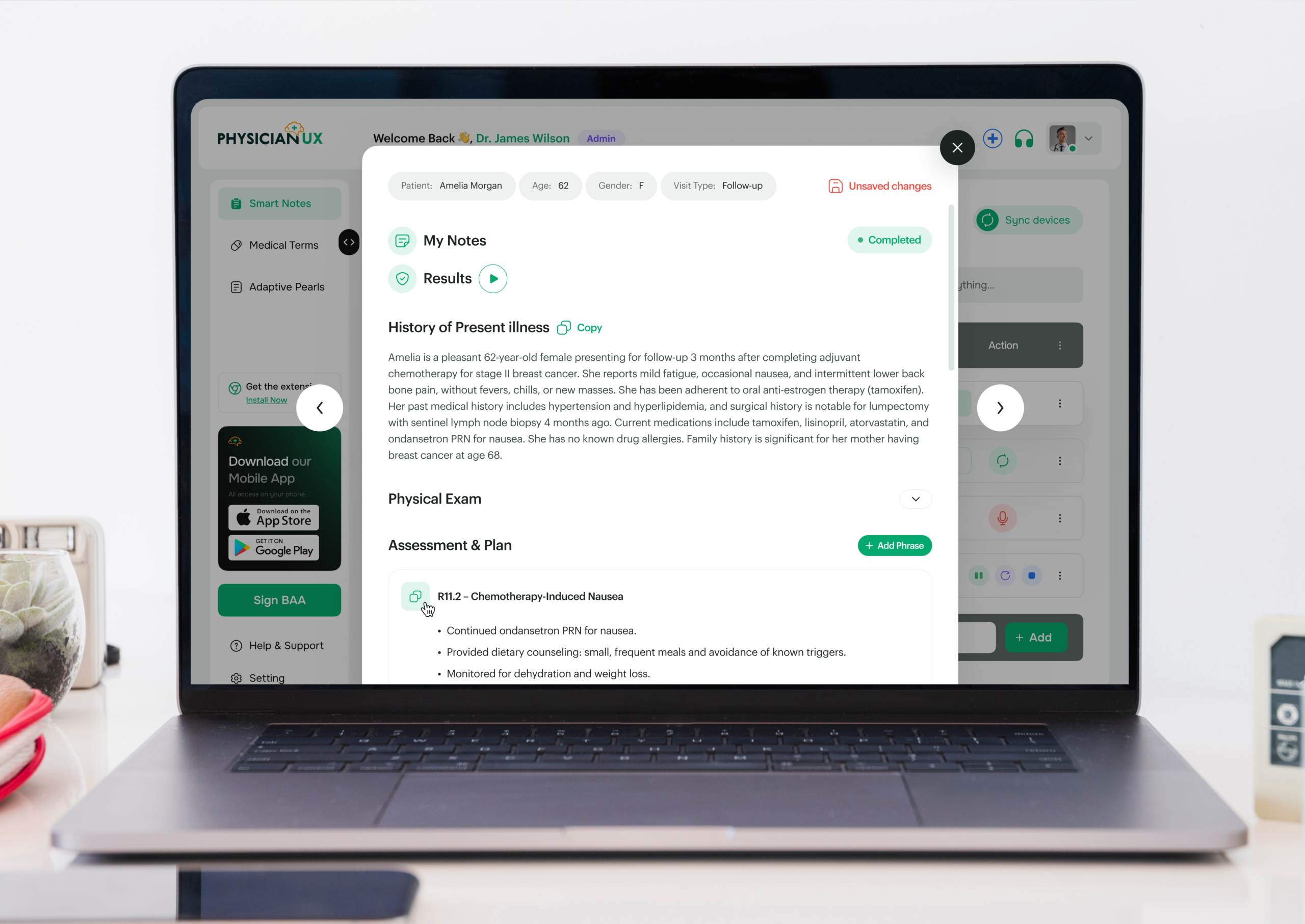
Oncology care unfolds over time — from diagnosis and staging to treatment decisions, symptom management, and survivorship. Each phase carries clinical and emotional weight, and documentation must reflect evolving reasoning, not isolated visits. Physician UX was designed to support this reality, capturing clinical conversations and producing notes that mirror how oncologists actually think and manage care.
If you practice Oncology, you know that notes often take longer than patient encounters. You must document detailed histories, treatment regimens, response assessments, side effect monitoring, and coordination with multidisciplinary teams — all while meeting strict regulatory and compliance requirements.
You’re capturing:
All while maintaining compassionate communication and patient-centered care — something no rigid template can fully support.
Oncology visits often require synthesizing multiple data points, documenting complex decision-making, and planning sequential treatments. By the time you reconcile labs, imaging, and treatment plans, the next patient is already waiting.
The cognitive load is intense. Missed details can affect outcomes, safety, compliance, and patient experience. Extended charting hours contribute to burnout and reduce time for meaningful patient interactions.
Physician UX lifts the documentation burden — without interrupting your workflow. It listens and structures notes in real time, supporting the complex rhythm of Oncology care.
Dr. Lee, an oncologist in a busy outpatient clinic, begins her day with six consecutive visits: chemotherapy management, follow-up imaging review, symptom assessments, and complex care coordination.
Typically, she would be mentally juggling labs, imaging, treatment updates, symptom management, and multidisciplinary communication — all while remaining attentive to each patient.
Today, Physician UX is listening in the background.
During her first visit, the platform structures a detailed HPI, treatment response, toxicity assessment, and symptom review. By the end of the conversation, her note already includes an aligned assessment and plan — with tasks queued for labs, imaging, and supportive care referrals.
Her second patient requires management of chemotherapy side effects and symptom counseling. Physician UX identifies key elements, surfaces pearls for toxicity management, and organizes tasks — all without slowing the encounter.
By mid-morning, Dr. Lee notices something rare: she is fully present with patients, not mentally reconstructing notes between visits.
Documentation that would normally extend into evenings is already complete. Tasks are organized, follow-ups mapped, and the burden of manual charting lifted. She can now focus on patient counseling, shared decision-making, and treatment planning.
What used to feel like constant triage now feels like practicing Oncology at full capacity.
When charting becomes lighter and less intrusive, patient care transforms. Physician UX ensures notes are accurate, timely, and aligned with best practices — freeing cognitive bandwidth for critical oncologic decision-making and patient-centered care.
Better notes also mean safer care:
In a specialty defined by complexity, precision, and human vulnerability, clarity isn’t optional — it’s essential.
Join the clinicians who’ve upgraded their workflow — and feel the difference for yourself.