Endocrinology is a specialty of systems, feedback loops, and long-term patterns. Each decision builds on what came before. Yet documentation tools often treat endocrine care like a single-visit problem.

Endocrinology is a specialty of systems, feedback loops, and long-term patterns. Each decision builds on what came before. Yet documentation tools often treat endocrine care like a single-visit problem.
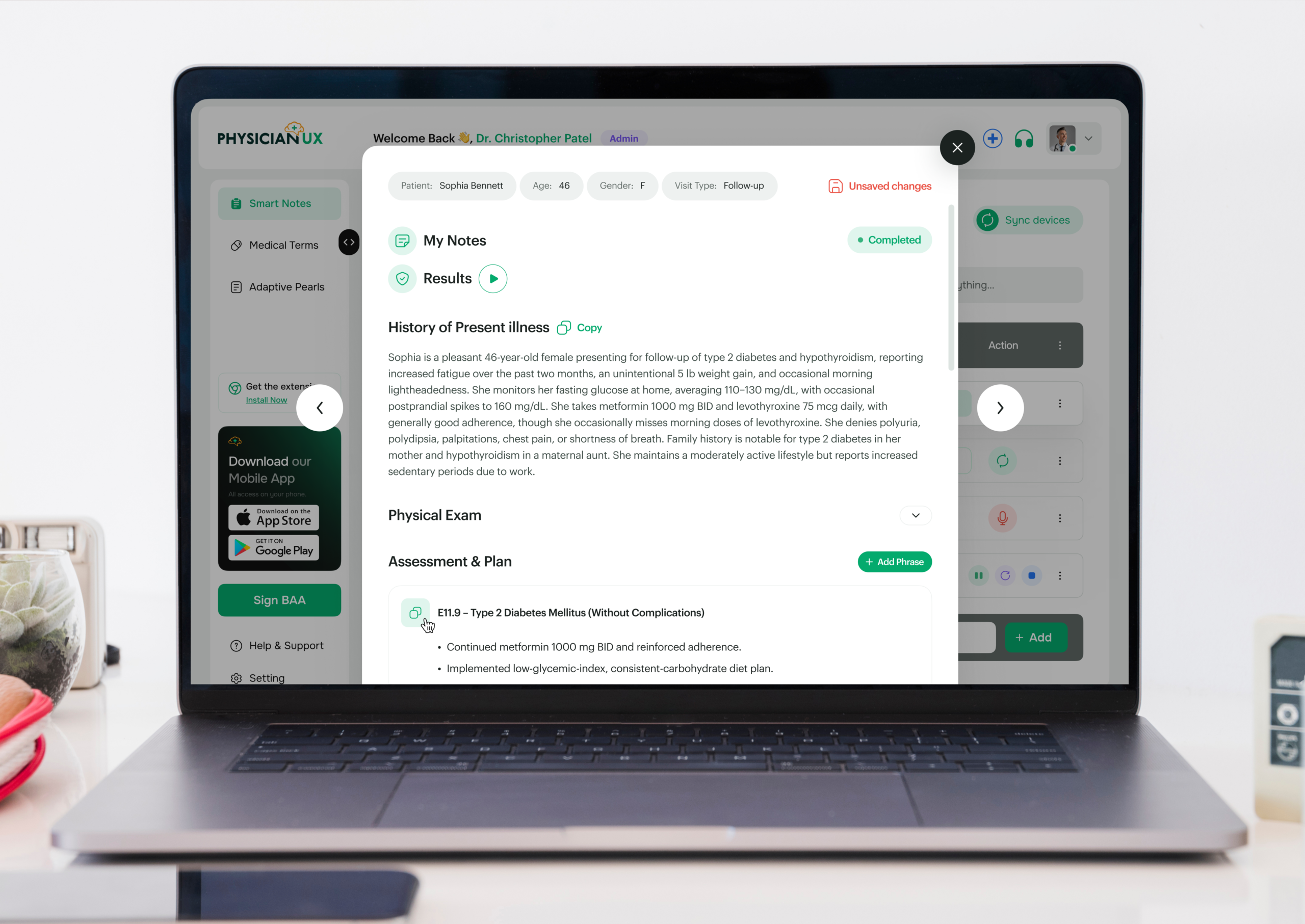
Endocrinology is defined by interconnected systems, feedback loops, and decisions that evolve over time. Small shifts in labs, symptoms, or adherence can change management entirely — yet most documentation tools treat endocrine care as a single-visit problem. Physician UX was designed to follow endocrine reasoning, capturing conversations and producing notes that reflect how endocrinologists actually think and manage care.
If you practice in Endocrinology, you already know the truth: notes often take longer than the patient encounter itself. The clinical conversation is nonlinear, highly detailed, and data-intensive — while documentation requirements are rigid and regulatory-driven.
You’re capturing:
All of this while trying to maintain a focused, patient-centered conversation — something no rigid template can support.
Follow-ups involve reviewing lab values, medication responses, lifestyle changes, and complication monitoring. By the time you update charts, schedule follow-ups, and coordinate multidisciplinary care, the next patient is already waiting.
It’s not just time-consuming — the cognitive load is heavy. Missed details can affect continuity, safety, compliance, and care coordination. And when documentation spills into evenings, burnout accelerates.
Physician UX was designed to lift the documentation burden — without interrupting your workflow. It listens and structures notes in real time, supporting the true rhythm of Endocrinology practice.
Dr. Patel, an endocrinologist in a busy outpatient clinic, begins her day with six consecutive visits: diabetes follow-ups, thyroid dose adjustments, adrenal insufficiency monitoring, and complex metabolic syndrome management.
Typically, she’d be mentally juggling lab trends, medication titrations, lifestyle updates, and complication monitoring — all while trying to remain focused for each patient.
Today, Physician UX is listening in the background.
During her first visit, the platform structures a nuanced HPI based on glucose logs, medication adherence, lifestyle changes, and comorbidities. By the end of the conversation, her note already includes an aligned assessment and plan — complete with tasks queued for labs, follow-ups, and specialist coordination.
Her second patient presents with fluctuating thyroid levels and cardiovascular risk factors. Physician UX identifies the clinically important elements and surfaces pearls related to dose adjustments, risk mitigation, and patient counseling — not generic text, but contextually relevant insights.
Halfway through the morning, she notices something unfamiliar: she isn’t drained. She isn’t behind. She’s actually thinking more clearly.
The documentation she normally finishes after clinic is already complete. Her tasks are organized, follow-ups mapped, and the weight of manual charting has lifted. She even finds herself engaging in deeper discussions that improve patient outcomes.
What used to feel like survival mode now feels like practicing medicine again.
When charting becomes lighter and less intrusive, the clinical encounter transforms. In Endocrinology — where lab trends, hormonal balance, and chronic care decisions shape outcomes — freeing cognitive bandwidth directly improves care.
You can stay fully present without splitting attention between typing, tracking labs, adjusting medications, or planning follow-up tasks.
Better notes also mean safer care:
In a specialty defined by complexity and long-term patient care, clarity isn’t optional — it’s essential.
Join the clinicians who’ve upgraded their workflow — and feel the difference for yourself.