Hematology demands precision — trends, thresholds, and subtle shifts guide high-stakes decisions. One missed detail can change management entirely. Yet documentation tools often fail to match the specialty’s rigor.

Hematology demands precision — trends, thresholds, and subtle shifts guide high-stakes decisions. One missed detail can change management entirely. Yet documentation tools often fail to match the specialty’s rigor.
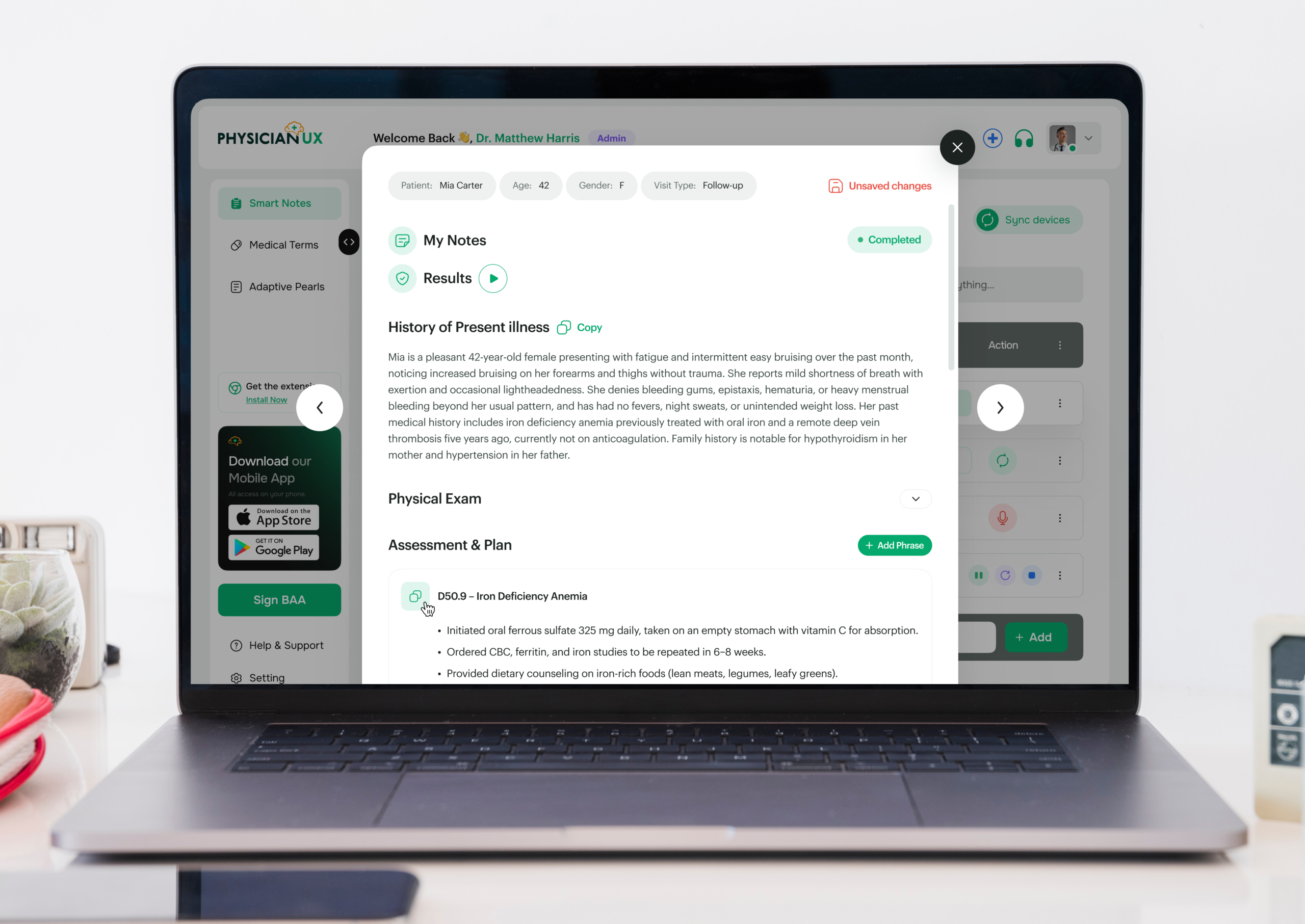
Hematology demands careful interpretation of trends, thresholds, and evolving clinical context — often with high-stakes implications. From anemia and coagulation disorders to hematologic malignancies, small changes can alter management entirely. Physician UX was designed to support this level of reasoning, capturing clinical conversations and producing notes that reflect how hematologists actually think and make decisions.
If you practice Hematology, you know that notes often take longer than the patient encounter. Visits frequently involve interpreting complex lab panels, tracking disease progression, managing anticoagulation, and counseling patients — while documentation requirements remain detailed, accurate, and legally essential.
You’re capturing:
All while ensuring accuracy for longitudinal care, clinical decision-making, and patient safety — something no rigid template can fully support.
Hematology visits often include multiple interdependent tasks. By the time you interpret labs, document interventions, and schedule follow-ups, the next patient is already waiting.
It’s not just time-consuming — the cognitive load is high. Missed details can affect safety, compliance, and communication. When documentation extends beyond clinic hours, burnout increases.
Physician UX was designed to lift the documentation burden — without interrupting your workflow. It listens and structures notes in real time, supporting the natural rhythm of Hematology.
Dr. Patel, a hematologist in a busy practice, begins her day with six consecutive visits: anemia evaluations, anticoagulation follow-ups, transfusion planning, and patients with hematologic malignancies.
Normally, she would be mentally juggling lab interpretations, medication adjustments, transfusion schedules, and patient counseling — all while staying attentive to each individual patient.
Today, Physician UX is listening in the background.
During her first visit, the platform structures a detailed HPI capturing symptom changes, lab trends, medication adherence, and treatment response. By the end of the conversation, her note includes an aligned assessment and plan — complete with tasks queued for labs, transfusions, and follow-ups.
Her next patient requires anticoagulation management and lab monitoring. Physician UX identifies clinically important elements, surfaces pearls for dosing adjustments, and highlights follow-up labs — all without slowing the encounter.
By mid-morning, Dr. Patel notices something new: she is fully present with patients, not mentally reconstructing notes between visits.
Notes are complete as visits conclude. Tasks are organized, follow-ups mapped, and the burden of manual documentation lifted. She can now focus on complex decision-making and patient counseling.
What used to feel like survival mode now feels like practicing medicine at her highest capacity.
When charting becomes lighter and less intrusive, the clinical encounter transforms. In Hematology — where lab interpretation, medication management, and transfusion planning intersect — freeing cognitive bandwidth directly improves care.
You can stay fully present without splitting attention between typing, tracking labs, adjusting medications, or coordinating care.
Better notes also mean safer care:
In a specialty defined by complexity, precision, and patient safety, clarity isn’t optional — it’s essential.
Join the clinicians who’ve upgraded their workflow — and feel the difference for yourself.