Andrology sits at the intersection of medical precision and deeply personal conversation. Every visit requires clinical accuracy without losing trust, nuance, or empathy. Most documentation tools disrupt that balance before the visit even ends.

Andrology sits at the intersection of medical precision and deeply personal conversation. Every visit requires clinical accuracy without losing trust, nuance, or empathy. Most documentation tools disrupt that balance before the visit even ends.
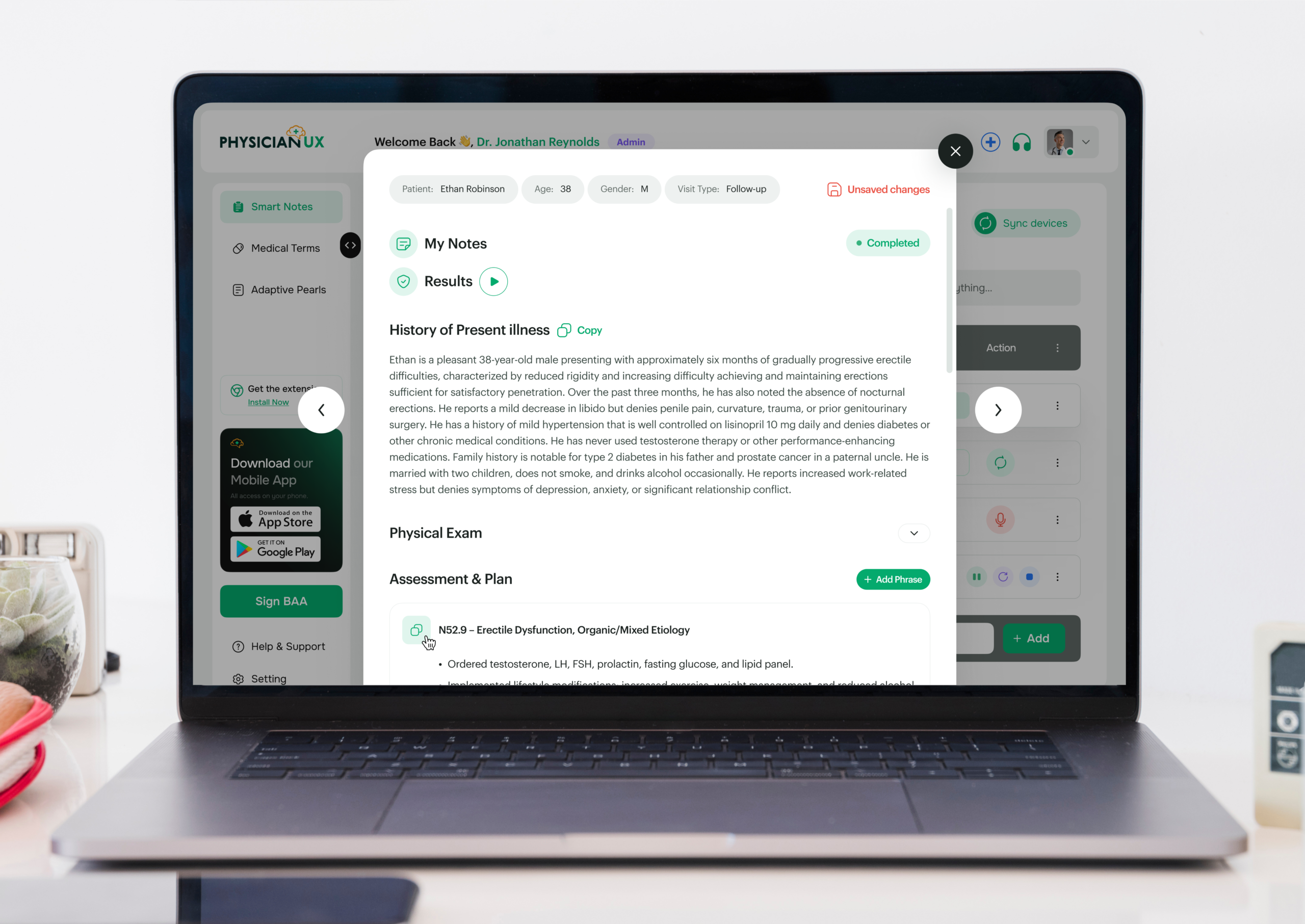
Andrology demands medical precision alongside trust, discretion, and thoughtful communication. Each visit balances complex physiology with deeply personal conversations — yet most EHR tools disrupt that flow. Physician UX was designed to support how Men’s Health clinicians actually think, counsel, and manage care without compromising the human connection that drives outcomes.
If you practice in Andrology, you already know that visits rarely follow a straight line. Sexual health concerns, fertility questions, hormonal issues, and genitourinary symptoms often overlap — and patients may disclose critical details late in the visit, requiring you to update multiple sections of the note.
You’re routinely documenting:
Then there’s counseling: expectations, safety, fertility timelines, lifestyle modification, medication risks, next steps. These aren’t quick conversations — and they don’t fit neatly into templated fields.
Plus, endocrine labs, imaging, hormonal trends, and semen parameters require precise longitudinal tracking. A missed detail can alter treatment decisions, delay fertility progress, or impact patient safety.
And inevitably, charting spills into the evening — adding mental fatigue to an already detail-heavy specialty.
Physician UX listens to your visit naturally and builds a structured, clinically aligned note — capturing not only symptoms but the nuance behind them. It reduces cognitive load so you can stay focused on the patient, not the screen.
Dr. Nolan begins his morning with a mix of concerns: an ED follow-up, a testosterone recheck, a fertility evaluation, and a patient with worsening urinary symptoms.
Normally he’d be juggling labs, timelines, psychosocial factors, relationship concerns, shared decision making, and long-term plans — all while trying to keep the conversation patient-centered.
Today, Physician UX is quietly working in the background.
During the ED follow-up, the platform captures the patient’s symptom progression, medication response, cardiometabolic updates, lifestyle contributors, and psychosocial elements. The note is drafted instantly, with an aligned plan and tasks queued for labs and follow-up.
Next, a fertility evaluation: semen analysis results, timing of intercourse, partner history, previous pregnancies, varicocele symptoms, and lifestyle factors. Physician UX structures the entire narrative into a clear, clinically relevant HPI with an organized assessment and plan.
For the first time in months, he isn’t mentally juggling ten separate plans. He feels present, steady, and fully engaged — without falling behind.
By lunchtime, his notes are done. Follow-up labs, imaging, and referrals are automatically organized. Patients get clearer plans, and he gets his time back.
Men’s Health is built on trust, communication, and longitudinal planning. When documentation becomes lighter, you gain bandwidth to address the sensitive issues patients often hesitate to bring up.
Better documentation supports:
When the mental strain of charting lifts, you can practice the kind of care men rarely receive — empathetic, thorough, and relationship-centered.
Join the clinicians who’ve upgraded their workflow — and feel the difference for yourself.