Emergency Medicine rarely offers clean narratives. Patients arrive mid-story, the clinical picture evolves minute by minute, and decisions carry immediate consequences. Documentation still demands structure — but it can’t slow the room down.

Emergency Medicine rarely offers clean narratives. Patients arrive mid-story, the clinical picture evolves minute by minute, and decisions carry immediate consequences. Documentation still demands structure — but it can’t slow the room down.
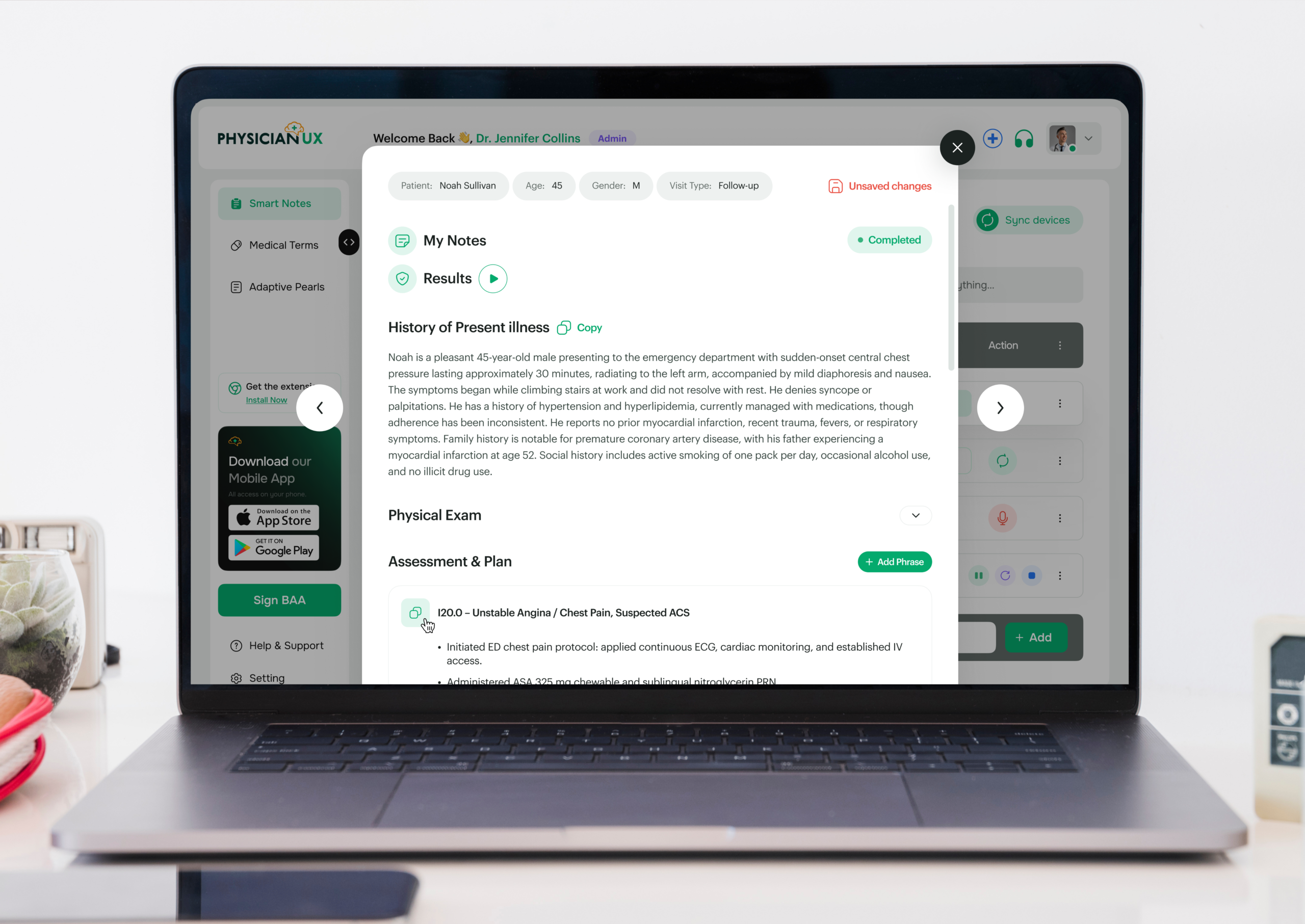
Emergency Medicine rarely offers clean narratives — patients arrive mid-story, and the clinical picture evolves minute by minute. Documentation still must be complete, precise, and defensible. Physician UX was designed to move at the same pace, capturing clinical reasoning without pulling attention away from the patient or the room.
If you practice Emergency Medicine, you already know the tension: the chart must be airtight, but the clock is always running. Your conversations are fragmented, your assessments evolve rapidly, and interruptions are constant — yet legally and clinically, your documentation needs to reflect complex decision-making.
You’re capturing, often simultaneously:
Every patient presents with uncertainty — chest pain that may not stay benign, abdominal pain that might evolve, behavioral health crises that shift unpredictably. And you’re juggling all of it while trying to stay present for the next stretcher rolling in.
Most templates don’t capture the nuance of real-time reasoning. They slow you down, break your momentum, and force you to reconstruct the entire visit after the fact — often hours later, when the details blur.
Physician UX adapts to the speed and structure of Emergency Medicine — giving you documentation that matches the acuity, complexity, and decision-making of your shift.
Dr. Patel walks into a fully loaded board: chest pain in bed 3, a febrile pediatric patient, shortness of breath in triage, and a possible appendicitis waiting for imaging. Before he even sits down, the pace accelerates.
Normally, he would start each assessment knowing the documentation will have to be reconstructed later — under time pressure, with details pulled from memory.
Today, Physician UX is listening quietly in the background.
During the first chest pain evaluation, the platform captures the patient’s risk factors, timeline, red flags, previous workups, and current ROS as Dr. Patel talks. It automatically aligns the note with appropriate cardiac workup logic, without adding clicks or forcing a rigid template.
Minutes later, he’s at the bedside of a child with fever and abdominal pain. While he examines, reassesses, and discusses next steps with the parent, Physician UX structures the note around pediatric red flags, hydration status, return precautions, and appropriate differentials — all without slowing him down.
By mid-shift, he catches himself doing something rare in Emergency Medicine:
staying fully present with patients instead of mentally drafting documentation in the background.
His progress notes, re-evaluations, MDM, and tasks are already aligned and organized. EMS handoffs, inpatient sign-outs, and procedure notes are cleaner and faster. Instead of scrambling to finish charts at 3 AM, he leaves with his mind clear.
When the chart reflects real-time thinking rather than reconstructed memory, every aspect of care improves — from continuity to safety to legal protection.
Physician UX directly supports better outcomes with:
Emergency Medicine will always be intense — but your documentation doesn’t need to carry the same weight. Better clarity means better patient safety.
Join the clinicians who’ve upgraded their workflow — and feel the difference for yourself.