Every Allergy & Immunology visit is a pattern in motion — symptoms, triggers, exposures, and response unfolding over time. Documenting that thinking is harder than making the diagnosis. This is where most tools fall short.

Every Allergy & Immunology visit is a pattern in motion — symptoms, triggers, exposures, and response unfolding over time. Documenting that thinking is harder than making the diagnosis. This is where most tools fall short.
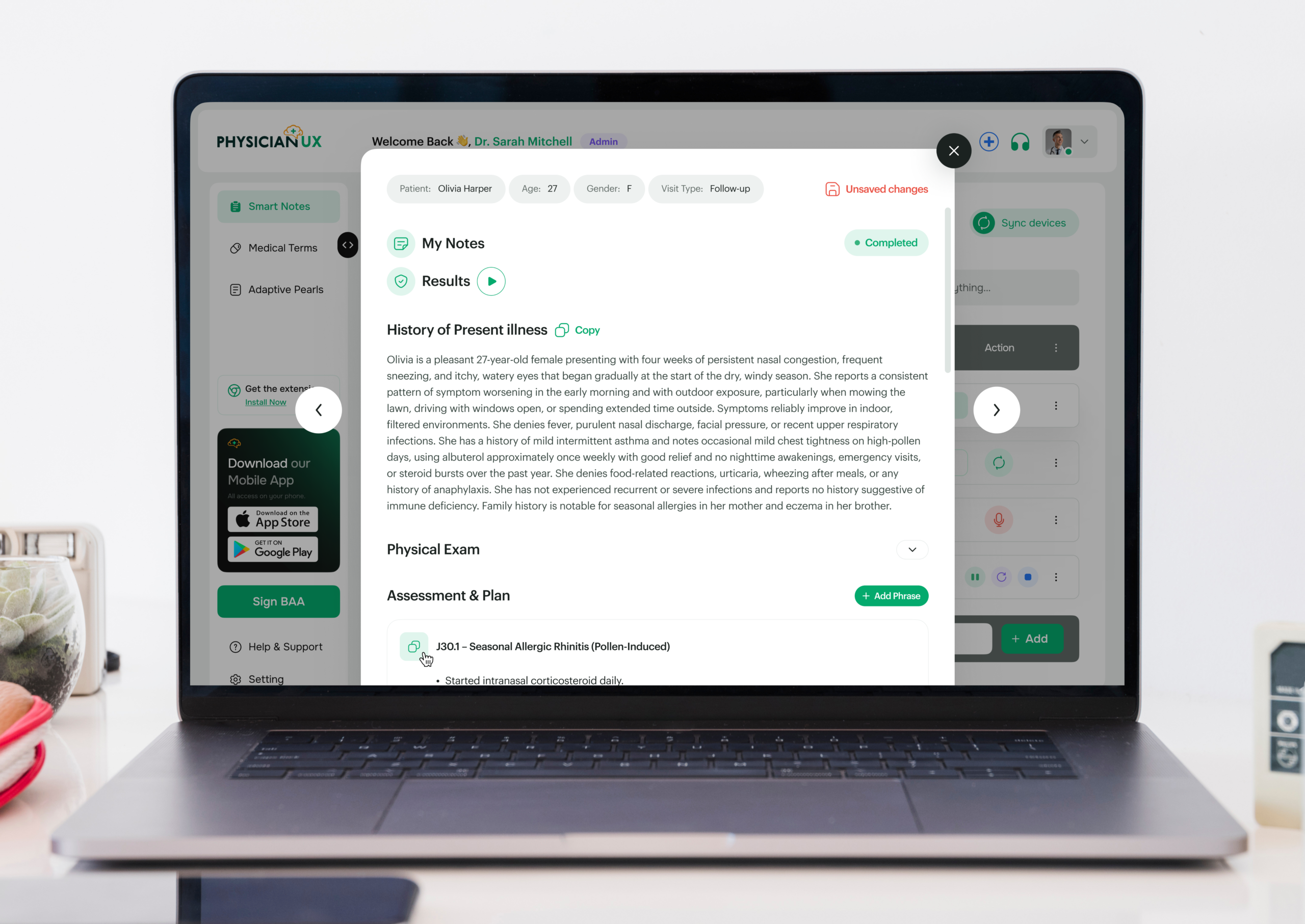
Allergy & Immunology is practiced through patterns — symptoms, triggers, exposures, and responses that unfold over time. Each visit builds on the last, and small details can change risk, diagnosis, and long-term management. Physician UX was designed with that reality in mind, capturing clinical conversations in a way that mirrors how allergists and immunologists reason, document, and plan care.
If you work in Allergy & Immunology, you already know the challenge: each visit is a blend of history, pattern recognition, test interpretation, and longitudinal tracking. The conversation jumps between symptoms, exposures, triggers, immunologic pathways, and multi-system manifestations — but documentation tools rarely keep up.
You’re capturing:
Meanwhile, your visits include long counseling discussions, safety planning, environmental control measures, biologic education, and shared decision-making — none of which fit neatly into rigid EMR templates.
Intake visits often exceed 45–60 minutes. Follow-ups still require documenting symptom trajectories, test results, exacerbation patterns, medication adherence, and long-term treatment strategies. By the time you’ve reviewed labs, interpreted allergen profiles, updated immunotherapy escalation, and documented reaction histories, you’re already behind schedule.
The cognitive load is real. Missing even a subtle detail can impact risk management, trigger avoidance, biologic eligibility, or immunotherapy planning. And when charting spills into evenings, burnout becomes inevitable.
Physician UX was created to lighten the documentation and decision-making burden — while allowing you to stay fully engaged with your patient. It follows your clinical reasoning, capturing the complexity of allergy and immunology without interrupting your flow.
Dr. Patel, an allergist running a high-volume clinic, begins her day with back-to-back visits: asthma flares, chronic urticaria follow-ups, a new food allergy evaluation, and an immune deficiency case.
Normally she’d be tracking symptom timelines, environmental exposures, testing results, biologic response patterns, and stepwise therapy decisions — all while keeping the visit moving.
Today, Physician UX is listening quietly in the background.
During the asthma follow-up, the platform structures the HPI automatically: daytime symptoms, nighttime awakenings, albuterol use, seasonal triggers, adherence patterns, lung function, and exacerbations. By the time she finishes the conversation, her note already includes a clear stepwise assessment and tailored action plan — with reminders queued for spirometry, FeNO, and medication refills.
Her next patient has chronic hives with recent angioedema. As she discusses patterns, medications, stress triggers, labs, and response to antihistamines, Physician UX surfaces contextual pearls: chronic spontaneous urticaria algorithms, when to consider omalizumab, and red-flag features for alternative diagnoses.
Mid-morning, she realizes she no longer feels like she’s mentally juggling twelve parallel workflows. The documentation is complete — and she’s actually ahead.
Her immunotherapy patients have clear dose histories and safety notes already structured. Her food allergy patient’s reaction timeline is fully captured with avoidance guidance and epinephrine training tasks queued automatically.
She finishes clinic on time — without sacrificing counseling, safety planning, or clinical thoroughness.
When documentation becomes lighter, the clinical encounter changes. In Allergy & Immunology — where outcomes depend on precise histories, pattern recognition, and patient education — reducing cognitive load directly improves patient safety and follow-through.
Better notes lead to better care:
In a specialty where subtle clinical details determine risk and management, clarity and continuity aren’t optional — they’re essential.
Join the clinicians who’ve upgraded their workflow — and feel the difference for yourself.